Ser vs Estar: The Only Rule You Actually Need
When to use ser vs estar in Spanish, explained with one simple rule, real examples, meaning-changing adjectives, and a short interactive self-test.
Nativia Team
English has one verb for "to be". Spanish split it into two and then let teachers spread a shortcut, ser for permanent things and estar for temporary ones, that collapses the moment you learn a dead person está muerto. Here is the version of the rule that actually survives contact with real conversations.
Quiz ahead: There is a short self-test at the end of this article, and question 2 looks easy but trips up most learners.Ser: what something is
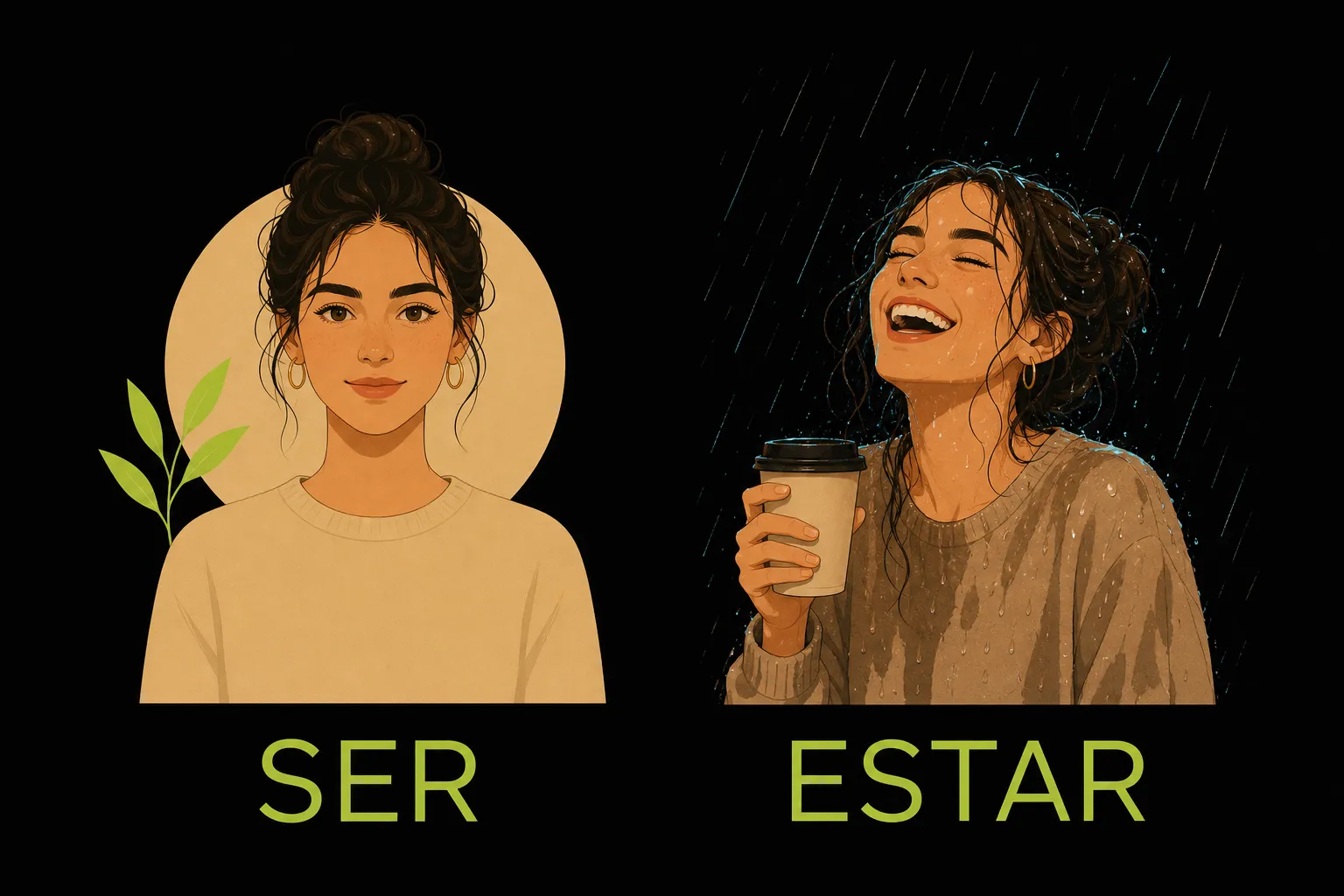
Ser classifies. Reach for it when you say what someone or something is: profession, nationality, origin, personality, defining traits, plus the time and the date.
- Sofía es enfermera y es de Medellín. (Sofía is a nurse and is from Medellín.)
- Mis abuelos son muy tercos. (My grandparents are very stubborn.)
- Hoy es martes y son las ocho. (Today is Tuesday and it is eight o'clock.)
If the sentence answers "what kind of thing is this?", you want ser.
Estar: how and where something is
Estar describes states and positions. Use it for the location of people and things, for moods and physical conditions, and for actions in progress with the gerund.
- Lima está en la costa. (Lima is on the coast.)
- Estoy agotada pero feliz. (I am exhausted but happy.)
- ¿Qué estás haciendo? (What are you doing?)
If the sentence answers "what condition is it in right now?" or "where is it?", you want estar.
Key takeaway:
- Ser answers what it is: identity, origin, traits, time.
- Estar answers how or where it is: location, feelings, conditions, anything in progress.

Reading is step one. Speaking is what makes it stick.
Practice this in a real conversation, with instant feedback.
The traps that catch everyone
The permanent rule fails exactly when you trust it
Mi bisabuelo está muerto. (My great-grandfather is dead.) Death is as permanent as it gets, yet it takes estar, because dying changed his state. Meanwhile soy estudiante (I am a student) takes ser even though you might drop out next semester. Duration never decides the verb. A change of state points to estar, a label points to ser.
Some adjectives switch meaning entirely
| Adjective | With ser | With estar |
|---|---|---|
| aburrido | boring | bored |
| listo | clever | ready |
| rico | rich (person) | tasty (food) |
| malo | bad, naughty | sick, or spoiled (food) |
Carlos es aburrido. (Carlos is boring.) Carlos está aburrido. (Carlos is bored.) One sentence insults him, the other invites him out.
Events ignore the location rule
El examen es en el aula 204. (The exam is in room 204.) But la profesora está en el aula 204. (The teacher is in room 204.) Things and people located somewhere take estar. Events take ser, even when you are only saying where they happen. A quick check: if it has a start time and an audience, use ser.
Test yourself
Choose ser or estar in each one, then check your answers.
Pick the right option in each sentence, then check your answers.
1.Mi hermano médico en Bogotá.
My brother is a doctor in Bogotá.
2.La sopa muy rica hoy.
The soup is delicious today.
3.Which sentence says the party happens at Ana's place?
4.¿Dónde el baño?
Where is the bathroom?
5.A friend texts you: Estoy aburrido. What are they telling you?
6.El café ya frío.
The coffee is already cold.
The cheat sheet
Save this for the next time you hesitate mid-sentence.
Ser vs estar at a glance
| You are saying | Verb | Example |
|---|---|---|
| Identity, profession | ser | Es profesora. (She is a teacher.) |
| Origin, nationality | ser | Somos de Chile. (We are from Chile.) |
| Personality, defining traits | ser | Eres muy amable. (You are very kind.) |
| Time and dates | ser | Son las dos. (It is two o'clock.) |
| Events, even their location | ser | La boda es en la playa. (The wedding is on the beach.) |
| Location of people and things | estar | Estoy en casa. (I am at home.) |
| Feelings and moods | estar | Está nerviosa. (She is nervous.) |
| Actions in progress | estar | Estamos comiendo. (We are eating.) |
| Result of a change | estar | El café está frío. (The coffee is cold.) |
Practice this grammar in real conversations
Rules only stick when you use them. Practice them in real conversations in Nativia and get instant grammar feedback after every message.
FAQ
Is ser for permanent things and estar for temporary ones?
No, treat that as a rough hint at best. Ask whether you are labeling what something is or describing its current state, and ignore how long it lasts.
Can both ser and estar be correct with the same adjective?
Yes, and the meaning shifts. Ana es nerviosa (Ana is a nervous person) describes her personality, while Ana está nerviosa (Ana is nervous) describes her afternoon.
How do I say where I am from versus where I am?
Origin takes ser and current position takes estar: Soy de Ohio, pero ahora estoy en Madrid. (I am from Ohio, but right now I am in Madrid.)
Keep reading
Stop Saying 'Estoy Caliente': 7 Tener Mistakes in Spanish
Estoy caliente does not mean you feel warm. Fix 7 common Spanish mistakes with tener, from tengo calor to tengo razón, plus a quiz and cheat sheet.
Por vs Para: How to Finally Choose the Right One
Confused by por vs para? Clear rules, real Spanish example sentences, common traps, and a quick self test to finally pick the right one every time.
7 Spanish False Friends That Will Embarrass You
Embarazada does not mean embarrassed. Learn 7 Spanish false friends that trip up English speakers, with fixes, memory hooks, and a self-test quiz.